Know-how: hydrogen in the lab
Cylinder or generator? What matters is the amount.
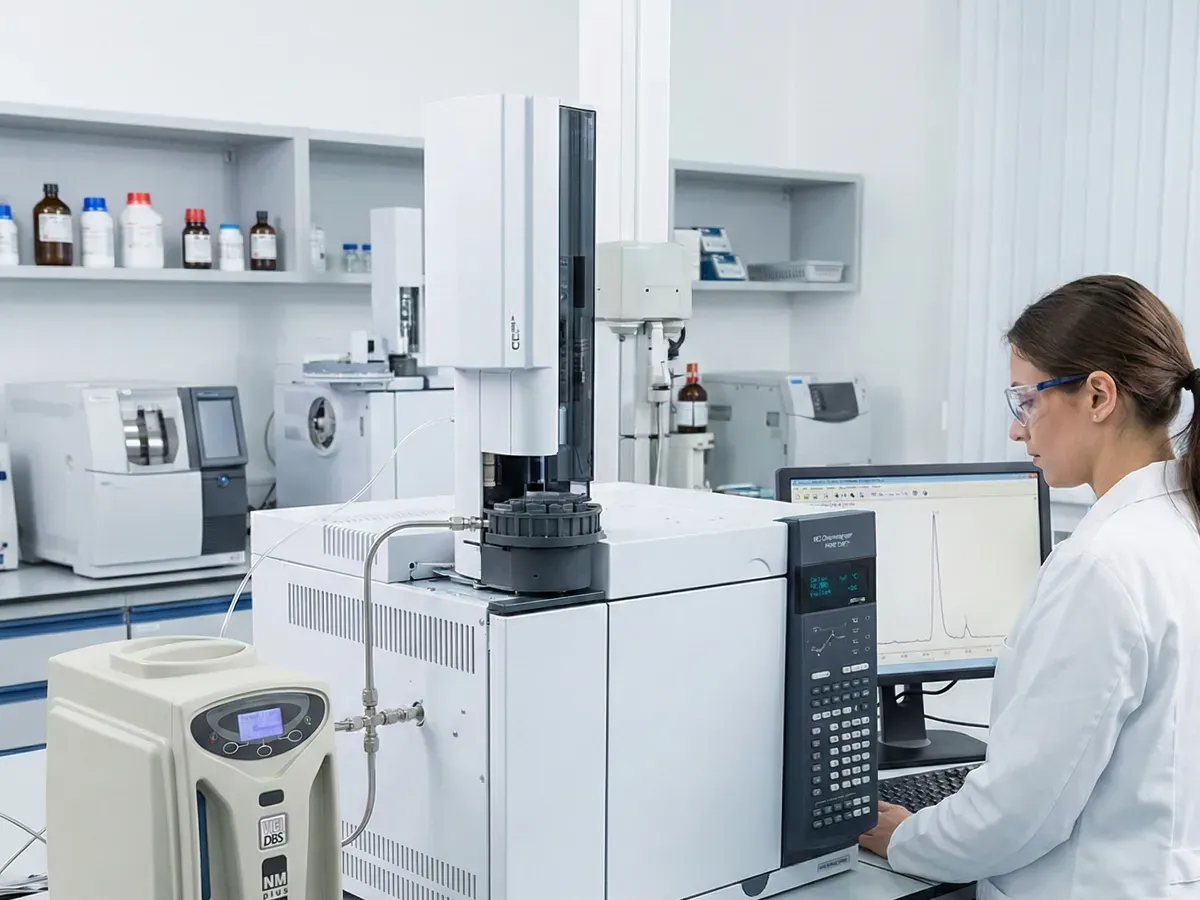
Hydrogen is the preferred fuel gas for the FID and increasingly the carrier gas in GC as well. It is also the most easily ignited gas in the lab. How dangerous it becomes depends on how much of it is on hand. A cylinder keeps several cubic metres in stock at high pressure. A SCHMIDLIN hydrogen generator produces only what your GC needs right now.
Same gas, different risk
The same hydrogen. The generator keeps it under control.
Hydrogen is the most easily ignited gas in the lab, whether it comes from a cylinder or a generator. The difference lies in how much of it is on hand and at what pressure.
A cylinder keeps several cubic metres at 200 to 300 bar in the room. A SCHMIDLIN hydrogen generator holds no stock. It produces exactly the gas your GC needs right now, at no more than 11 bar, and shuts itself down on a leak.
| Property of H₂ | From a cylinder | From a generator |
|---|---|---|
| Explosive range 4–77 vol% | A single failure can release the entire stock, far beyond the explosive limit. | No more than the rated output can flow, so the concentration in the room stays far below the explosive limit. |
| Minimum ignition energy 0.017 mJ | A small spark during a cylinder change or at a fitting is enough. | No cylinder changes, no high-pressure fittings in the lab. |
| Colourless and odourless | A leak at the valve or regulator goes unnoticed until a gas warning system responds. | Integrated sensors detect internal and external leaks and shut the generator down. |
| 14 times lighter than air | An escaping stock collects under the ceiling. | Small amounts quickly dilute in the room air. |
| Warms up on expansion | When gas escapes at 200 to 300 bar, the jet can ignite without an external ignition source. | No more than 11 bar outlet pressure. |
| Invisible flame | A fire at the cylinder valve is barely visible in daylight. | Without a stock there is no gas source to keep it burning. |
Substance data from the GESTIS database. Instrument data from the data sheets of the VICI DBS hydrogen generators.
The decisive factor
How much hydrogen can escape in your lab?
A cylinder is a stock: if it fails, its entire content can escape. A generator only produces hydrogen on demand. Even in the worst case it delivers no more than its cell can produce per hour.
| Source | Can escape | Concentration in the room |
|---|---|---|
| 50 L cylinder | 9–12.5 m³ at once | ≈ 16–22 vol%, four to five times the lower explosive limit |
| 10 L cylinder | ≈ 1.8 m³ at once | ≈ 3.5 vol%, above the explosive limit under the ceiling |
| NM Plus generator | max. 81 L per hour | ≈ 0.16 vol%, about 4 % of the lower explosive limit |
Rough calculation: 50 m³ room, complete mixing. For the generator, one air change per hour and the worst case that it keeps running at full output despite a leak. In reality it shuts down on a leak, and labs with mechanical ventilation usually have a much higher air change rate. In practice the generator value is therefore even lower.
Stock versus supply
The cylinder runs empty. The generator keeps delivering.
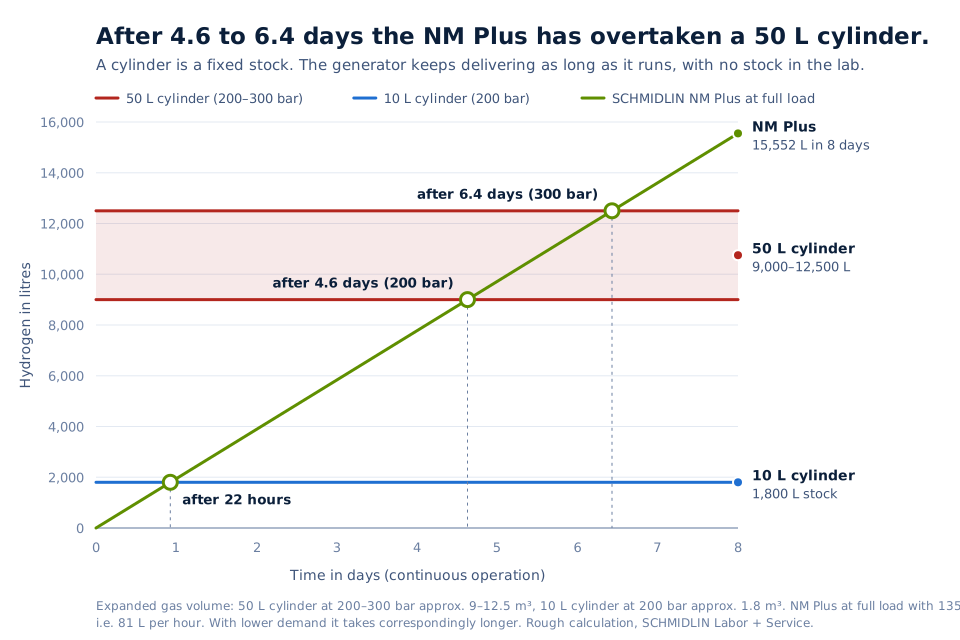
Sooner or later a cylinder is empty and has to be changed. At full load the NM Plus delivers 81 litres per hour, day and night. After 22 hours it has produced as much hydrogen as a 10 L cylinder holds, after 4.6 to 6.4 days the content of a 50 L cylinder. It even produces the content of a bundle of twelve 50 L cylinders (107 to 151 m³) in 55 to 78 days, without outdoor storage, piping or bundle changes. And there is never a stock in the lab.
Inside the instrument
Where the cylinder becomes a risk in GC and GC-MS.
Leak in the column oven
If a capillary column breaks or a fitting comes loose, hydrogen flows into the closed oven. According to Shimadzu, 40 mL/min into 15 litres reaches the lower explosive limit after 15 minutes. At 500 mL/min, a 40-litre oven gets there in just over three minutes. With a generator, no high-pressure stock keeps flowing, and it shuts down on a leak.
Power failure at the GC-MS
Agilent warns: if the power fails, GC and MS stop, but the cylinder keeps supplying gas. Hydrogen can accumulate in the vacuum system and explode when the pumps restart automatically. A generator without power produces no more hydrogen.
Shut-off at the source
According to the manufacturer, VICI DBS hydrogen generators shut down automatically on an internal or external leak, overpressure and low water. An oven or room sensor can also cut the generator's power. A cylinder needs its own shut-off valve for this.
What matters is how much can keep flowing behind the GC: several cubic metres from a cylinder, no more than the rated output from a generator. And on a leak, it shuts down.
Regulations
The requirements a cylinder brings. And what a generator removes.
In Germany, hydrogen in the lab is governed mainly by the Hazardous Substances Ordinance, the Industrial Safety Regulation, TRGS 526 “Laboratories”, TRGS 510 on storage and DGUV Rule 113-001 on explosion protection.
| Topic | Hydrogen gas cylinder | Hydrogen generator |
|---|---|---|
| Location | Under TRGS 526, generally outside the lab, with gas supplied through permanently installed lines. Inside the lab only as an exception and with the smallest possible container. | Sits right next to the instrument or in the lab. No compressed gas is stored. |
| Storage in the workroom | Under TRGS 510, only in safety cabinets (G30 to G90 per EN 14470-2) with mechanical exhaust to the outside. | No compressed gas container, so no storage of compressed gas. |
| Explosion protection | During withdrawal, at least 120 air changes per hour in the cabinet so that no Ex zone forms there. Otherwise Zone 2 with explosion-protected equipment. | The risk assessment starts from a small, limited release rate instead of several cubic metres in stock. |
| Inspections | Ventilation and gas warning systems every year, the explosion-protected installation at least every six years (German BetrSichV, Annex 2, Section 3). | No inspections for a gas cylinder cabinet and its exhaust. SCHMIDLIN service handles maintenance, the Smart Box monitors the condition. |
| Handling | Transport with protective cap and cylinder trolley, secured against falling, leak test at every cylinder change, never run completely empty. | No cylinder changes. Just top up deionized water. |
| Pressure | 200 to 300 bar in the container. | No more than 11 bar outlet pressure. |
General information, not legal advice. The current version of the rules and the operator's risk assessment are what count.
Making the switch
What a SCHMIDLIN generator changes in your lab.
Less gas in the room
Instead of several cubic metres in stock, only the gas your GC needs right now is present. The risk shrinks by orders of magnitude.
Simpler assessment
Your risk assessment works with a small, limited release rate instead of a high-pressure stock. The gas cylinder cabinet and the inspection of its exhaust are no longer needed.
No cylinder handling
No moving heavy cylinders, no changes in the middle of a sequence, no leak test after every connection. Just top up deionized water.
Monitored around the clock
The SCHMIDLIN Smart Box reports anomalies to our service team, often before anyone in the lab notices. We plan maintenance according to the actual condition.
Cascade up to ten units
As your demand grows, connect up to ten NM Plus in parallel. You get more output and built-in redundancy: while one unit is being serviced, the others keep supplying your GCs. You still need no gas stock.
Consistent purity
Up to 99.99996 % hydrogen, day after day. No air or moisture entering during cylinder changes and no variation from batch to batch.
For your safety officer
The data for your risk assessment.
Whether a switch to a generator succeeds often depends on the safety officer. We compile the information they need: the instrument's maximum hydrogen flow, shut-off functions, outlet pressure and an example calculation for your room. That makes the assessment quick.
Request instrument data- Tell us about room and instrumentsRoom size, ventilation and the GCs that need hydrogen.
- Choose the generatorWe size the right generator with headroom.
- Receive the dataData sheet, shut-off logic and example calculation for your records.
Frequently asked questions
Hydrogen in the lab: the key questions.
Your question is not listed? Get in touch.
- Is a hydrogen generator safer than a cylinder?
It reduces the biggest risk: the amount that can escape at once. A 50 L cylinder holds 9 to 12.5 m³ of hydrogen at 200 to 300 bar. A generator produces the gas on demand at no more than 11 bar and shuts down on a leak, overpressure or power failure.
- Does a generator make the risk assessment simpler?
Yes. It no longer has to account for a high-pressure stock of several cubic metres, only for a small, limited release rate. The gas cylinder cabinet with exhaust, cylinder changes and the related inspections no longer apply. We supply your safety officer with the instrument data.
- Can I use hydrogen as carrier gas instead of helium?
Yes, and many labs do because of shorter run times and helium shortages. Hydrogen is then also present in the injector, the column and, where applicable, the mass spectrometer. That is exactly when a generator is the better source: it delivers consistent purity up to 99.99996 % and shuts down on a power failure instead of continuing to flood the MS. We size the generator for carrier and fuel gas together with you.
- What if one generator is not enough for my lab?
One NM Plus supplies up to 33 GCs with up to 1350 mL/min. If you need more, cascade up to ten generators. They work as one system and back each other up: if one unit fails or is being serviced, the others keep delivering. Your supply grows with your lab without adding a high-pressure stock.
- How much effort does running a generator take?
Very little. You top up deionized water, and our service team handles maintenance on site in Germany and Austria. With the SCHMIDLIN Smart Box we spot anomalies early and plan maintenance according to the actual condition.
- What happens during a power failure?
Without power there is no electrolysis, so the generator stops producing hydrogen. A cylinder, by contrast, keeps supplying gas as long as the valve is open. Agilent therefore recommends closing the hydrogen source after a power failure before the MS pumps down again.
Less hydrogen in the room. More peace of mind in the lab.
We will show you what a SCHMIDLIN generator saves in your lab in safety equipment, inspections and cylinder logistics.
or by email to info@schmidlin-labor.de